"Do I contradict myself? Very well, then, I contradict myself.
I am large, I contain multitudes." -- Walt Whitman, Song of Myself
(Do I predict myself...)
Bear with me. I'm going to glue some things together.
FIRST: Concerning the Eminent Directors Anderson
It was a banner year for those of us softcore cinephiles (and I don't mean fans of "Emmanuelle in Rio") who prefer Contemporary American Indie/Auteur films to the French New Wave, which laps quietly at the southern shore of our Netflix queue: there were new films by young stalwarts Wes and P.T. Anderson (Darjeeling Limited and There Will Be Blood, respectively).
Both films are good. But PTA's TWBB is better. You can prefer apples to oranges.
And I wonder whether it's because Wes is building model ships inside of bottles, if his career isn't shaping up to be a Russian Nesting Doll with less and less room to move, so that he is relegated to constructing curios in miniature.
precious, adj.
1. a. Of great moral, spiritual, or other non-material value; beloved, held in high esteem ...
3. Aiming at or affecting refinement in manners, language, etc.; fastidious, particular. Now usu. depreciative: over-delicate, over-fastidious; affectedly refined in matters of taste, language, etc. (Oxford English Dictionary)

I propose that Wes Anderson Phase One ends after the first three films (Bottle Rocket, Rushmore, The Royal Tenenbaums) and that those of us who were so shook by those have to come to grips with Phase Two, in which some of the merits of those earlier works - elaborate set design, exhaustive soundtracking, and oceans of whimsy - are inflated at the cost of ... something. WA was always bothways precious, cool, at some distance from us. But there seemed to be blood pumping through those stories. And I'm beginning to surmise that there won't be blood anymore. Darjeeling was, well, limited. A train in vain.

Now PT Anderson's films up to this point had all been very similar (the non-essential Hard 8, Boogie Nights, Magnolia, and Punch Drunk Love, where he admittedly took a couple of big swings, cutting his usual 3hr runtime in half and casting Adam Sandler). But TWBB is really nothing like them. And what it leaves behind is this sort of meta-ironic gimmickiness - which I loved but was very "of its moment" in the sense that Dave Eggers is of his ... the kind of thing you'd expect to be surprised by. But this new one, love it or like it, has a full head of steam. It's epic without frogs, without Aimee Mann, without ensemble, without prosthetic dongs.
Though each director / film deserves much more time, I'll train my untrained eye elsewhere, because this isn't a review from a hill, it's a question: what do we make of artists of all stripes trapped in their own style? AND SUBQUESTION: what does stylization do to what we'll call (for lack of better phrase) substance - the flesh, the bone, the hangnail, the teeming viscera of recognizability?
ADVOCATING FOR THE DEVIL, I'll proffer that the deservedly lauded No Country For Old Men is not very human. Before you hit me, let me say that I loved it and I think it might be the Coens' "best" film, but (and I can't testify whether this follows from McCarthy) it felt like allegory to me ... all about forces (pitchdark ones), violence in the abstract. Yes, Brolin and Jones seemed to be lit from within despite their heroic stoicism, but still.
(And it's a good and related question that's been asked about where the women are in these muscley works of art - TWBB and NCFOM. Even the new Apatovian regime, which I think has done a service to mainstream comedy, is blatant homosociality. The women are straight man to the male patter.
Heigl said so herself.)
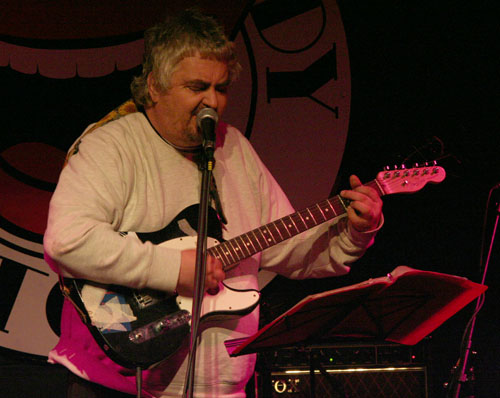
((Yes I realize that I have populated this post with pictures of men. Men I have straight crushes on. Certainly not part of the solution. Very well then ... ))
OFFSCREEN, this links to other conversations.
LISTEN: we played a game at the bar where you have to name the album that "epitomizes" the band's sound. For instance, despite your (and everyone else's) affection for The Bends, the answer for Radiohead is OK Computer. But is it a valid question? A good one? Do we resent bands extending themselves?
TANGENTIALLY:
lyric, adj.
1. Of or pertaining to the lyre; adapted to the lyre, meant to be sung; pertaining to or characteristic of song. Now used as the name for short poems (whether or not intended to be sung), usually divided into stanzas or strophes,
and directly expressing the poet's own thoughts and sentiments (OED, my emphasis)

What of lyrical obscurity? What in the hell is Stephen Malkmus ever talking about?Shaggy locks and crooked smile, we hardly knew ye. Dylan is the ur-sphinx here. But still there are claims that some of his albums are v. personal. Is it braver to strum with heart put to sleeve? Or the narrative songwriter, like The Decemberists' Colin Meloy ... can we find him amidst the wags and swains of his erudite period pieces? Do we prefer our indie rock lyrics so far underground, populated by erstwhile pomo poets? Then again, what's the alternative ... emo?
(FOOTNOTE - BEYOND EMODOME ((Emodome is a palindrome)) the most "emo" song I've ever heard might be
the Bee Gees' "I Started A Joke")

ENDING THE JOKE: A really ready model for this question of access / stylization is the stand-up comedian. I have said that Patton Oswalt is better than Galifianakis or Mitch Hedberg because he comes across in his monologues, they work from a sort of very familiar racounteurism. I don't know if he would agree, but he seems to be him. The other guys tell jokes, often one-liners. Funny things they thought of, not stories. To me, the analogy is that the Simpsons will always be a better show than Family Guy though Family Guy is funnier. On FG the stories are a place to hang the gags. And this divide plays out both ways with the titans of standup. Both Lenny Bruce and Richard Pryor made material of their real lives and problems. Then again, Andy Kaufman made a kind of performance art out of never being there, all guises.
Who do we want them to be?
 The occasion for this post is a salon.com article about Daniel Day-Lewis in There Will Be Blood. The article quotes a professional actor puzzled by all the lauding of Day-Lewis: "Weird how so many people confuse 'acting that you can see' with great acting," he says. NOW I'm pulling for DDL on Sunday ... that performance was one of the most stunning, memorable, most enormous things I've ever seen in a film. Perhaps rivaled only by DDL in Gangs of New York. But I think the article might be on to something.